

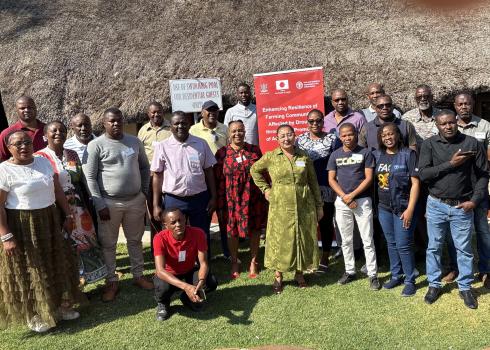
Otjiwarongo, Namibia – The Government of Namibia, with support from the Japan-funded drought resilience project and the European Union-funded Support Towards the Operationalization of the SADC Regional Agricultural Policy (STOSAR II) Project implemented by the Food and Agriculture Organization of the United Nations (FAO), conducted a Livestock Emergency Guidelines and Standards (LEGS) training in Otjiwarongo to strengthen national capacity for livestock emergency preparedness and response. Through STOSAR II, FAO provided technical expertise for the training, drawing on certified LEGS facilitators and technical specialists from the project team.
The training brought together 58 extension personnel from Erongo, Hardap, Kunene, Omaheke and Otjozondjupa Regions, many of whom work in drought-prone and livestock-dependent areas. As frontline service providers, they play an important role in supporting communities affected by livestock-related emergencies.
Livestock production is a critical source of livelihoods, food security and income for rural communities across Namibia. However, recurrent droughts, rangeland degradation, water scarcity, feed shortages and disease outbreaks continue to affect livestock-dependent households.
Against this backdrop, the training forms part of anticipatory action to strengthen preparedness ahead of the 2026/27 rainy season, with El Niño conditions predicted and the latest Southern African Regional Climate Outlook Forum (SARCOF) outlook indicating an increased likelihood of below-normal rainfall across Namibia and much of central and southern SADC. These forecasts further highlight the importance of early action to reduce the impacts of potential livestock emergencies.
Opening the training, representatives of the Government of Namibia and FAO highlighted the need for timely, risk-informed and evidence-based livestock emergency interventions. They noted that recent climate and disaster events demonstrate how quickly shocks can affect livelihoods, infrastructure and vulnerable communities where preparedness systems are inadequate.
The training introduced participants to LEGS principles and approaches for designing, implementing and evaluating livestock interventions in emergencies. Through presentations, facilitated discussions, group exercises and case studies, participants explored how livestock-based responses can protect livestock assets while supporting crisis-affected communities.
Participants applied the LEGS four-stage emergency response planning framework: emergency assessment, response identification, response analysis and response planning, supported by monitoring, evaluation, accountability and learning. Practical sessions enabled them to assess possible livestock interventions and consider how preparedness measures can be integrated into animal health, livestock development and disaster risk management systems.
Speaking during the training, facilitator Elma Zanamwe underscored the importance of strengthening national and subnational capacity to respond effectively to livestock emergencies.
“LEGS provides a practical framework that helps practitioners make informed decisions that protect both livestock and livelihoods. By strengthening these skills within institutions, countries are better positioned to anticipate, prepare for and respond to emergencies affecting livestock-owning communities,” she said.
Participants also valued the opportunity to exchange experiences across Namibia’s regions and apply LEGS concepts to challenges faced by livestock keepers.
“The training strengthened my understanding of how to assess livestock emergencies and identify response options based on local needs. The knowledge and tools gained will enhance our ability to support livestock-owning communities during times of crisis and contribute to building resilience,” said one participant.
The training was supported through complementary contributions from the European Union-funded STOSAR II Project and FAO Namibia’s Japan-funded drought resilience initiative. Through facilitators from the STOSAR II team, the project provided the technical support for the delivery of the LEGS training as part of its wider regional work on animal health, emergency preparedness and early action. STOSAR II supported the technical delivery of the training as part of its regional work on animal health and emergency preparedness, while the Japan-funded initiative supported the participation of regional officers working with communities affected by drought and other livestock emergencies.
Through this technical support, STOSAR II is strengthening national and regional capacity to respond to climate shocks and transboundary animal diseases, while protecting livestock-based livelihoods, food security and regional trade.
The training strengthens Namibia’s ability to plan and implement livestock emergency interventions using internationally recognized standards, while supporting the protection of livestock-dependent livelihoods and food security.
At the conclusion of the training, participants received certificates recognizing their successful completion of the course and their commitment to applying the knowledge gained within their respective regions and institutions.