

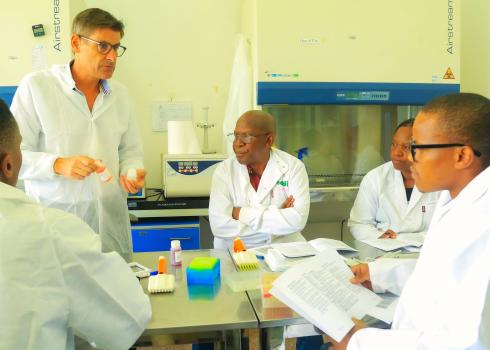
DAR ES SALAAM, Tanzania – Veterinary laboratory personnel from Southern African Development Community (SADC) Member States strengthened their ability to diagnose Peste des Petits Ruminants (PPR), a disease affecting sheep and goats, and improve laboratory quality management during a five-day regional training. Held from 26 to 30 October 2026 at the Tanzania Veterinary Laboratory Agency (TVLA), the training focused on producing reliable test results to support disease detection and control.
The Food and Agriculture Organization of the United Nations (FAO) organized the training in collaboration with the French Agricultural Research Centre for International Development (CIRAD) and TVLA. It was delivered under the European Union-funded Support Towards the Operationalization of the SADC Regional Agricultural Policy Phase II (STOSAR II) project.
Regional assessments and consultations had identified gaps in diagnostic capacity, quality control, proficiency testing and readiness for laboratory accreditation. The training addressed these gaps through practical learning and exchanges among laboratory personnel.
Why stronger laboratories matter
PPR is a highly contagious viral disease that threatens food security and the livelihoods of smallholder farmers and pastoral communities who depend on sheep and goats for income and nutrition.
Livestock movement and cross-border trade can spread the disease across national boundaries. Preventing and controlling PPR therefore requires coordinated regional action, reliable laboratory testing and timely information sharing among veterinary authorities.
Dr Elma Zanamwe, STOSAR II Project Coordinator, explained how the training contributes to the project’s wider regional objectives.
“The STOSAR II Project is supporting this training because effective control of transboundary animal diseases depends on strong veterinary capacities and coordinated action across borders. The training strengthens the ability of SADC Member States to detect, report and respond to animal health threats using harmonized and risk-based approaches. It directly supports STOSAR II’s wider objectives of strengthening veterinary services, implementing regional disease-control strategies, improving cross-border surveillance and information sharing, and ultimately protecting livestock livelihoods and facilitating safer trade.”
Building practical diagnostic and quality management skills
Two complementary modules ran concurrently, combining theoretical instruction, hands-on laboratory exercises, demonstrations and peer learning.
The PPR Laboratory Diagnostic Methods module strengthened skills in laboratory testing, interpreting results and applying quality-assurance procedures. Practical sessions covered enzyme-linked immunosorbent assay (ELISA), nucleic acid extraction and reverse transcription polymerase chain reaction (RT-PCR).
The Quality Management Systems (QMS) module focused on practices that help laboratories produce consistent, reliable results. It covered ISO/IEC 17025, the international standard for the competence, impartiality and consistent operation of testing and calibration laboratories.
Topics included managing documents and records, assuring and controlling quality, metrology (the science of measurement), identifying work that does not meet requirements, taking corrective action and making continuous improvements.
Participants also identified practical steps to strengthen quality systems in their institutions and, where applicable, work towards laboratory accreditation.
Dr Arnaud Bataille emphasized that technical support would continue beyond the training. He is a Senior Researcher and Virologist at CIRAD and Head of the World Organisation for Animal Health (WOAH), FAO and European Union Reference Laboratories for PPR.
“With this training, we are giving the national reference laboratories of SADC Member States the tools to consistently produce reliable PPR diagnostic results, which is a key element in the current effort to stop the disease from spreading further in the region, and ultimately eradicate it from the region and the rest of Africa. Our work will not stop at this training event. CIRAD and its local collaborator, the Tanzania Veterinary Laboratory Agency, will continue their support to laboratories of the region beyond this specific training to ensure long-term improvement of their capacity.”
Tanzania’s role in regional disease surveillance
Located between Eastern and Southern Africa, Tanzania plays a strategic role in regional disease surveillance. Effective surveillance and early detection are particularly important to help prevent PPR from spreading further south into neighbouring countries, including those currently free from the disease.
Mr Denis Kalabi Nyakilinga highlighted TVLA’s contribution to strengthening national and regional veterinary services. He is a Livestock Research Officer and the Head of the Diagnostic Section at TVLA's Centre for Infectious Diseases and Biotechnology (CIDB) laboratory.
“As a co-facilitator, the Tanzania Veterinary Laboratory Agency (TVLA) contributes laboratory infrastructure, technical expertise, and practical learning in collaboration with FAO, CIRAD, and veterinary laboratory experts from SADC Member States. This training strengthens diagnostic skills, laboratory procedures, quality management, and the timely detection and confirmation of Peste des Petits Ruminants (PPR).”
The training also supports TVLA's ambition to become a PPR reference laboratory. It strengthens the agency’s capacity to provide technical guidance, training and mentorship to other veterinary laboratories, local government authorities and frontline veterinary personnel.
Sustaining progress towards PPR eradication
At the conclusion of the training, 16 participants received certificates: 10 in PPR Laboratory Diagnostic Methods and six in Quality Management Systems. By strengthening diagnostic skills and laboratory quality systems, the training will support more reliable disease surveillance and regional efforts to eradicate PPR, helping protect livestock livelihoods and facilitate safer trade.