

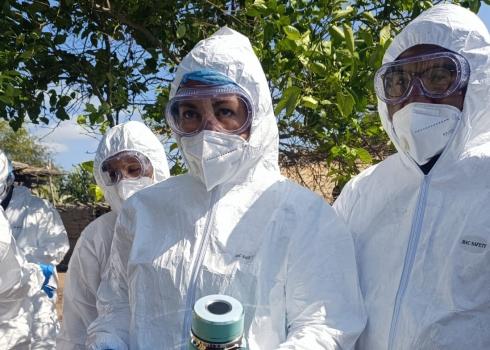
Taolagnaro - Madagascar conducted a simulation exercise on Foot-and-Mouth Disease (FMD) and Peste des Petits Ruminants (PPR) from 15 to 17 September 2026 in Taolagnaro to assess the country’s preparedness and response arrangements for these priority transboundary animal diseases.
The exercise tested existing contingency plans, coordination mechanisms and outbreak response procedures, providing government veterinary officials from the Ministry of Agriculture, Livestock and Fisheries with an opportunity to evaluate their readiness to detect, report and respond to potential disease incursions.
Supported through the European Union-funded 'Support Towards the Operationalization of the SADC Regional Agricultural Policy Project (STOSAR II)', implemented by FAO in partnership with the SADC Secretariat, the exercise forms part of wider efforts to strengthen animal health preparedness and response capacities in SADC Member States. Strengthening national readiness to manage transboundary animal diseases also contributes to protecting livestock-dependent livelihoods and supporting safe regional trade in animals and animal products.
Particular attention was given to assessing the implementation of biosecurity, biosafety, and disease prevention measures, especially at the Ehoala Port in Taolagnaro. The exercise also tested notification, data transmission, and coordination mechanisms among relevant stakeholders in the event of a suspected disease occurrence, helping to evaluate the effectiveness of communication and response systems.
The simulation generated valuable lessons and recommendations to strengthen national animal health emergency preparedness and response capacities. Findings from the exercise are expected to inform improvements to contingency planning, coordination, communication, and operational response mechanisms for FMD and PPR.
The activity represents an important step towards enhancing Madagascar's resilience to transboundary animal diseases and safeguarding livestock health, productivity, and livelihoods. It also contributes to STOSAR II’s wider efforts to strengthen animal health systems and support safe regional trade across Southern Africa.