

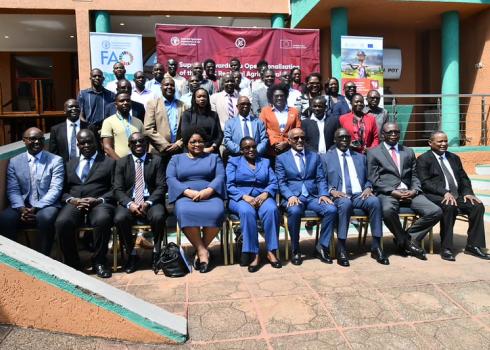
The Government of Malawi, in collaboration with the Food and Agriculture Organization of the United Nations (FAO), the Southern African Development Community (SADC) and the European Union (EU), has officially launched the second phase of the Support Towards the Operationalization of the SADC Regional Agricultural Policy (STOSAR II) project.
STOSAR II is a EUR 10 million initiative funded by the EU under the Development of Smart Innovation through Research in Agriculture (DeSIRA) programme. Building on the achievements of the first phase of the STOSAR implemented from 2018 to 2024, STOSAR II will accelerate the transformation of agriculture and agrifood systems across the 16 SADC Member States, including Malawi.
The first phase of the STOSAR project strengthened Malawi’s agricultural information systems by upgrading the National Agriculture Management Information System (NAMIS), enhanced animal health systems by strengthening transboundary disease surveillance and laboratory diagnostic capacity, including training veterinary staff and equipping laboratories to detect priority diseases such as Foot-and-Mouth Disease, and improved pest surveillance and export readiness through capacity building and supporting the development of Integrated Pest Management strategies.
The project will support Malawi in strengthening its agricultural food systems through four priority areas which include Agricultural Information Management Systems (AIMS), improved market access through strengthened plant and animal health systems, sustainable value chain development, and enhanced food and nutrition security.
Speaking at the STOSAR II launch, Mr. Ali Said Yesuf, FAO Representative in Malawi, said “We stand ready to support the Government of Malawi’s vision through FAO’s technical assistance, aligned with national priorities to strengthen agricultural productivity, reduce import dependence and promote local value addition.”
The project will also strengthen collaboration among stakeholders, enhance policy coherence and promote knowledge sharing across the region. By fostering stronger partnerships and coordinated action, STOSAR II contributes to more resilient, inclusive and competitive agrifood systems.
The Secretary for Agriculture, Irrigation and Water Development of Malawi, Erica Maganga, expressed appreciation to the EU for its support to the implementation of STOSAR II, saying “Through the financial resources provided for the STOSAR II project, the EU has demonstrated not only solidarity with the Government of Malawi, but also with the Southern African Development Community (SADC) as a whole. This investment in the agriculture sector is a clear testament to the EU’s belief in the transformative power of agriculture to drive economic growth, enhance food security, and uplift the livelihoods of our farmers.”
STOSAR II supports the implementation of the SADC Regional Agricultural Policy (RAP), adopted in 2013 to advance sustainable agricultural growth, food and nutrition security, and regional integration. The RAP is closely aligned with the Comprehensive African Agricultural Development Programme (CAADP), launched in 2003, and the CAADP Strategy 2026–2035 under the Kampala Declaration. Through this alignment, STOSAR II contributes to food security, climate resilience, inclusive growth and agro-industrialization in Malawi and across the region.
The launch brought together representatives from government ministries, development partners, private sector actors, farmer organizations, research institutions and the media, underscoring the importance of a multi-stakeholder approach to agricultural development.