

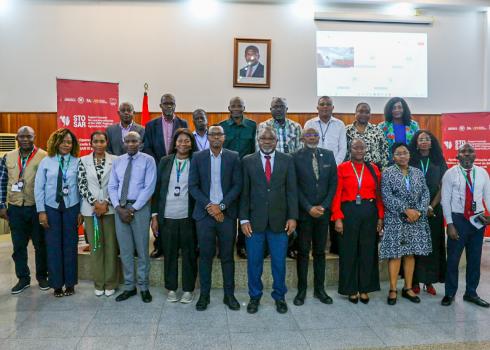
Luanda, Angola - From 8 to 20 March 2026, the Food and Agriculture Organization of the United Nations (FAO), in collaboration with Angola’s Ministry of Agriculture and Forestry (MINAGRIF), conducted a Food Balance Sheets (FBS) Training and Compilation Workshop in Luanda under the European Union-funded Support Towards the Operationalization of the SADC Regional Agricultural Policy Phase II (STOSAR II) Project.
The workshop brought together members of Angola’s National Food Balance Sheets Technical Working Group (TWG), including statisticians and technical experts from government institutions, academia and research organizations. Their participation reflected the multi-sectoral nature of Food Balance Sheets and reinforced national ownership of the process.
The training aimed to strengthen Angola’s capacity to independently compile, update and maintain high-quality Food Balance Sheets in line with FAO international standards. Through a combination of conceptual learning and practical exercises, participants enhanced their understanding of the updated Supply Utilization Accounts (SUA) and Food Balance Sheets methodology while gaining hands-on experience using the FAO Food Balance Sheets Compilation Tool.
Why Food Balance Sheets Matter
Food Balance Sheets are a cornerstone of national food and nutrition statistics. They provide a comprehensive overview of a country’s food supply during a given reference period, covering production, imports, exports, stock changes and utilization for food, feed, seed, processing and other purposes. By converting these data into per capita food availability and nutrient indicators, Food Balance Sheets generate valuable insights into food security and nutrition trends.
They also support evidence-based policymaking by generating key indicators such as the Import Dependency Ratio and the Self-Sufficiency Ratio. These indicators help governments assess vulnerabilities in food supply chains, monitor reliance on external markets and design informed agricultural, trade and nutrition policies. For Angola, strengthening Food Balance Sheets production will support improved planning, monitoring and evaluation of strategies aimed at enhancing food security, nutrition outcomes and the resilience of agrifood systems.
The updated FAO methodology, which incorporates a robust Supply Utilization Account framework, standardized commodity trees and improved statistical processes, has significantly enhanced the analytical value and international comparability of Food Balance Sheets. These advances, however, require strong national technical capacity and effective institutional coordination needs directly addressed through the Luanda workshop.
From Training to Practical Compilation
In addition to theoretical sessions, the workshop placed strong emphasis on practical capacity development. Members of the Technical Working Group worked directly with national datasets on agricultural production, trade, stocks and utilization, updating and harmonizing Supply Utilization Accounts for the period 2020–2024.
Supported by an FAO international consultant and FAO headquarters experts, participants learned how to identify and address data gaps, resolve imbalances and validate outputs generated by the Food Balance Sheets Compilation Tool.
By the end of the workshop, preliminary Food Balance Sheets covering five consecutive years (2020–2024) had been produced. These outputs provide estimates of food availability for human consumption, expressed in terms of energy (kilocalories), proteins, fats, vitamins and other macro- and micronutrients per capita per day at the commodity level. The Food Balance Sheets also provide proxy estimates of post-harvest food losses.
While some data inconsistencies remain to be resolved through follow-up technical support, the exercise provided participants with valuable practical experience and strengthened their confidence in independently managing future Food Balance Sheets compilation cycles.
Expected Impact and Way Forward
The workshop strengthened Angola’s capacity to produce high-quality, policy-relevant Food Balance Sheets that will support evidence-based decision-making across the food security, nutrition, agriculture and trade sectors.
The training concluded with the awarding of certificates to participants in recognition of their successful completion of the programme. In the coming weeks, Angola’s Food Balance Sheets Report for the period 2020–2024 will be finalized and published. Continued regular compilation of Food Balance Sheets by the national technical team will be essential to ensure the sustainability and institutionalization of this critical statistical product.